Take a market maker holding both sides of the same prediction market position—LeBron James over 20 points, LeBron James under 20 points. The two should cancel out; they can never both hit. But on Kalshi or Polymarket today, that market maker still has to post full capital against each leg separately, tying up cash that's economically already covered.
That inefficiency is where ParlayX wants to sit, co-founder and CEO Andrew Gonzalez says on The BettingStartups Podcast. The company, which he built with co-founder Antonio Cosio, sits on top of prediction market exchanges as a permissioning and capital-control layer. A fund can carve out a "pod," fund it with a slice of its balance sheet, assign specific traders to it, and set policies down to which markets they can trade and how much buying power they get. Custody, wallet management, and API-key credentialing come bundled in—a fix for an industry where entire trading desks currently share one login and one set of credentials, which Gonzalez says is a major security issue.
The company didn't start here. ParlayX began as a retail aggregator built around market discovery before Gonzalez concluded the retail customer was too hard to define—several similar tools have already shut down. "I'd rather know who my customer is than try to guess," he said. The institutional definition has narrowed too: early conversations centered on betting syndicates, but ParlayX now builds exclusively for market makers, who want granularity where retail wants abstraction.
Gonzalez is candid about the ceiling on seat-based software alone. At roughly $2,000 a month per market maker and maybe 100 total customers in the category, "that's just not very investible, to be quite frank." The bigger opportunity is netting—seeing a market maker's exposure across every exchange at once, something no single venue can do on its own. Kalshi is building its own netting tools, but "Kalshi can only see the exposures for the market maker on their own platform." ParlayX wants to be the layer that sees all of them, eventually issuing short-term loans against netted portfolios and charging exchanges per connection rather than charging the desks, sort’ve like the “Plaid for prediction markets,” in Gonzalez’ words.
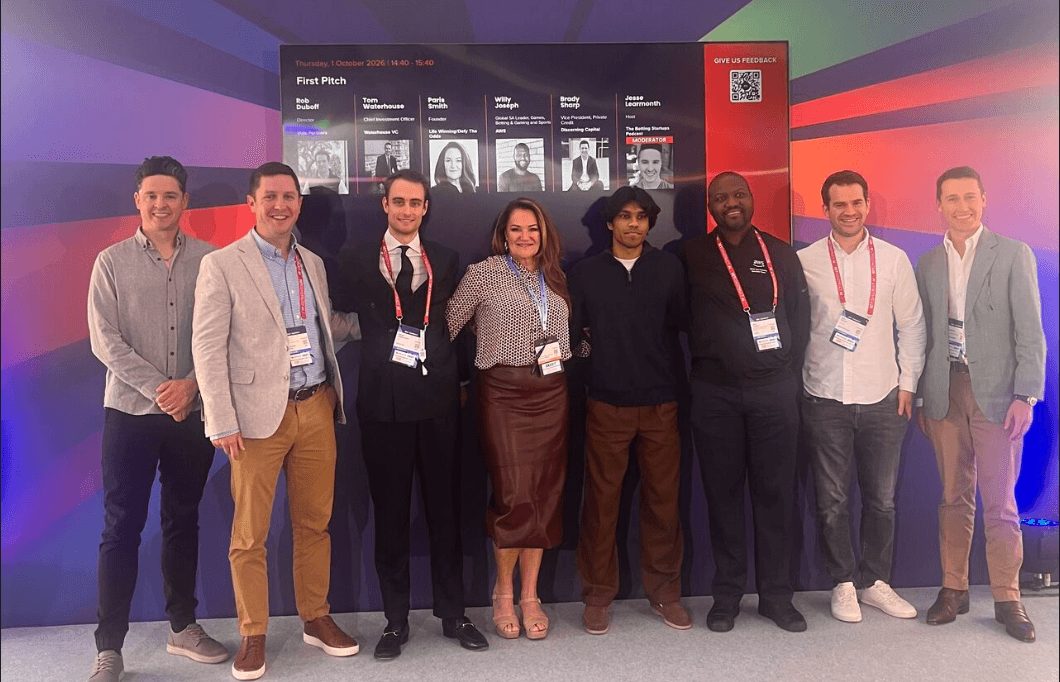
Five market makers are live on the platform today, with a target of 15 to 20 within three months. The momentum follows a First Pitch win at SBC Summit Americas in June, where ParlayX took home the competition's $100K prize before officially launching earlier this month. ParlayX closed a seven-figure round in May and is finalizing a smaller angel close it expects to announce in September, backed by a major sports affiliate and advisors including DraftKings alum Jeffrey Haas.
On the regulatory noise swirling around sport event contracts, Gonzalez isn't worried. More rules, in his view, mean more fragmentation, "and that's kind of the issue that we're trying to resolve anyways… if anything, I think that’ll help." Five years out, he wants ParlayX to be the orchestration layer institutions route through by default—selling netting data to the exchanges themselves the way Plaid sells connections to banks.
Listen to the full podcast on YouTube, Spotify, and Apple Podcasts.