Over 300 people self-exclude from UK gambling platforms every single day. Alec Gehlot has spent the last four years watching that number climb—first from inside the industry, working with major operators and CRM platforms including Optimove, and now from the outside, building a startup called PlaySignal to address it. |
His argument isn't that self-exclusion is broken, but that it arrives too late. By the time a player opts out, often for five years at a stretch, the outcome is permanent—for the player and for the operator. "When someone self-excludes," Gehlot said on the podcast, "that is not something that is recoverable." |
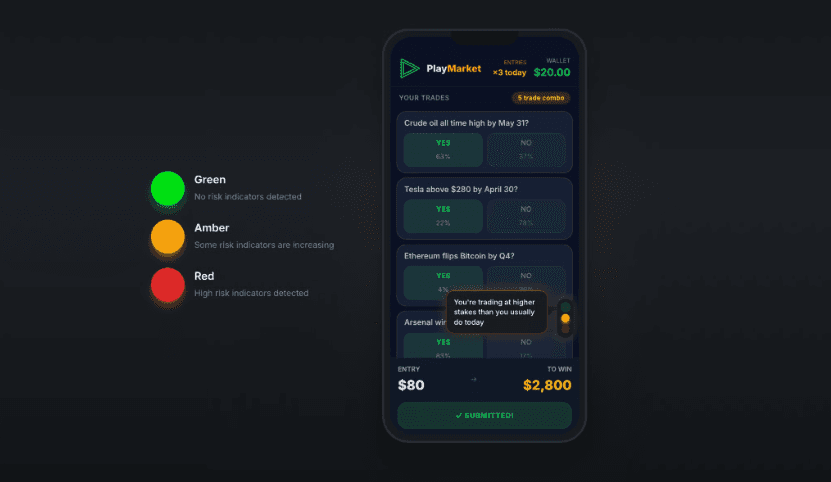
PlaySignal is a front-end responsible gaming tool built to intervene before that moment. The product runs on a traffic light system—green, amber, red—each corresponding to a different level of player risk. At green, it surfaces behavioral data for the player: session length, deposit totals, win/loss position. |
Think of it, Gehlot says, like an Apple Watch for gambling behavior—always present, never punishing. Amber triggers a nudge, a short personalized message flagging that a session is running longer than usual, framed as support rather than restriction. Red is the most distinctive step: a screen takeover with a calming animation—breathing exercises, still imagery—designed to break the loop of play before any mandatory operator intervention kicks in. |
The product also has a compliance layer. PlaySignal feeds risk signals into operator CRM systems in real time, meaning marketers stop sending bonuses to high-risk players and compliance teams catch problems earlier, with fewer cases reaching the desk. "We're trying to bring both worlds together in a neat way," Gehlot said. |
Gehlot frames this as a generational shift in how the industry thinks about RG. His taxonomy: RG 1.0 was hard rules and deposit limits. RG 2.0 was machine learning models predicting risk scores in the back office. RG 3.0, where he positions PlaySignal, is taking that intelligence and putting it directly in front of the player in a way they can understand and act on. The shift, as he describes it, is from an operator-led back-office function to something player-facing that supports self-regulation in real time. |
UK remote gambling tax is set to jump from 21% to roughly 40%, and the licensed market's share of UK gambling has dropped from 97% to around 92%, Gehlot says, while regulated operators are under pressure from every direction. Gehlot's pitch to those operators is that player protection is the one thing regulated platforms have that offshore operators don't. "Rather than constantly trying to constrain the marketers," he said, "we actually have a tool now which they could look at and be like, 'Oh, great. This is actually helping us to form a better marketing strategy. We're no longer sending out promotions to players which are at very high risk because that's not beneficial for our business.'" |
PlaySignal is currently bootstrapped and focused on a handful of UK operator rollouts over the next 12 months—building the case studies that, Gehlot hopes, will make the argument for what RG can look like when it's designed to keep players in, not push them out. |
Listen to the full podcast on YouTube, Spotify, and Apple Podcasts. |
PlaySignal wants to reach at-risk players before self-exclusion, and not after
The London-based startup is building a real-time, player-facing RG tool—and argues the industry's current approach is intervening too late.
Published: Jun 10, 2026